What if your firm's most prominent clients could track every deepfake of themselves online?
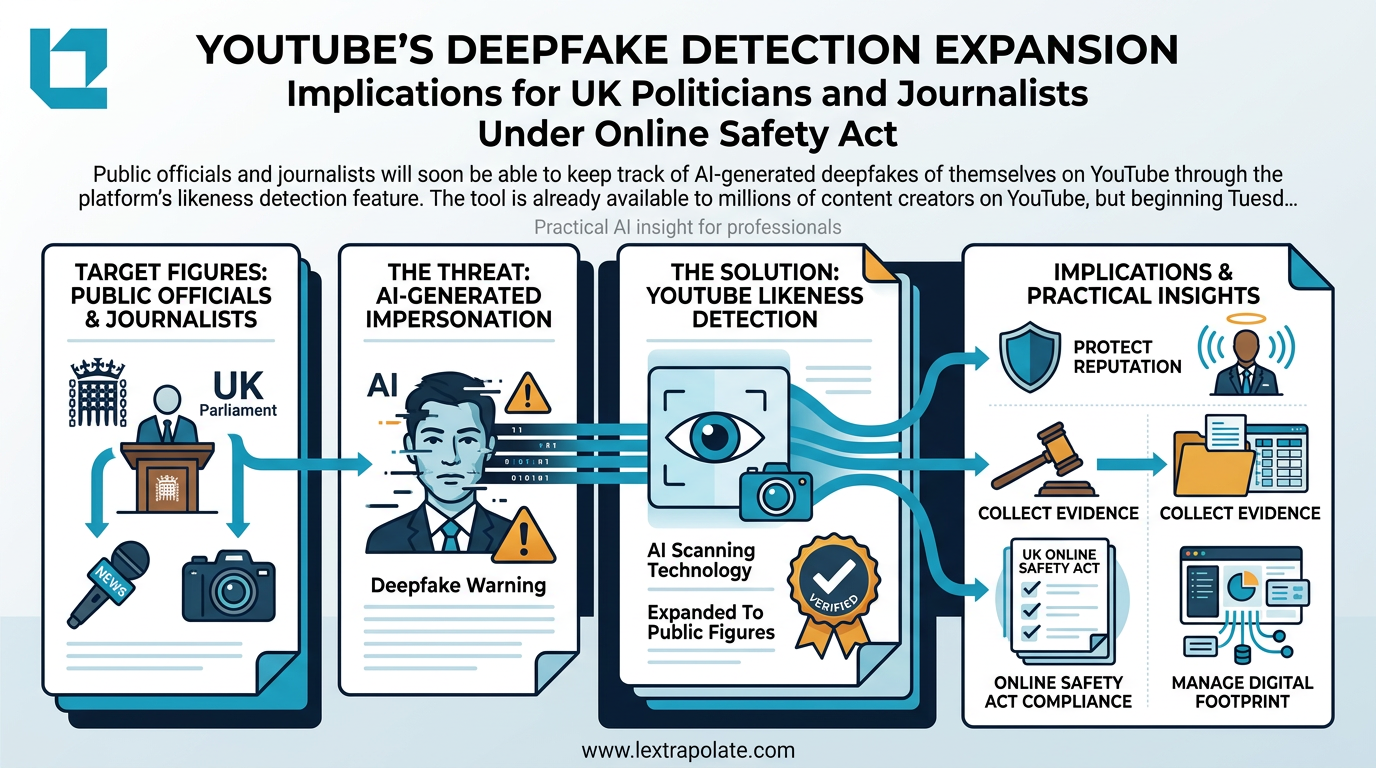
Deepfake impersonation of high-profile clients is no longer a theoretical risk for UK law firms; it is an operational vulnerability. While the Online Safety Act 2023 and GDPR provide a statutory backdrop, the speed of synthetic media requires a proactive 'Deepfake Protocol' that most firms currently lack.
This is not a hypothetical drawn from a thriller. It is the kind of incident that professional advisers are increasingly being asked to manage after the fact, without having prepared for it in advance.
The deepfake threat to high-profile individuals is no longer a niche concern. The tools required to generate convincing synthetic video and audio of a real person are widely available, cheap, and improving quickly. What is lagging behind is the professional infrastructure to monitor for, respond to, and legally address this kind of impersonation when it targets clients.
The detection problem is partially solvable
YouTube has been developing a likeness detection tool, initially rolled out to content creators, that works on a principle similar to its existing Content ID system. Rather than matching copyrighted audio or footage, it matches faces. A user registers their likeness by submitting a selfie alongside verified identification. The system then surfaces content that appears to feature their face without authorisation. They can review matches and request removals, subject to platform policy, which carves out satire and commentary.
That last caveat matters. Platforms do not and cannot commit to removing every piece of synthetic content. They will weigh editorial and expressive considerations. A deepfake of a politician saying something they did not say may still survive a removal request if it is framed as satire, however thinly.
For professional advisers, this means detection is only the first step. The more consequential question is what legal remedies are available once a deepfake has been identified, and how quickly those remedies can be deployed.
The UK legal framework: stronger than most people assume
UK law offers more traction here than is commonly appreciated, across several overlapping frameworks.
The Online Safety Act 2023 imposes obligations on platforms to address harmful content, including synthetic media used to deceive or harass. Where a deepfake is sexually explicit, the position has strengthened further: the Criminal Justice Bill has moved to criminalise the creation of non-consensual intimate deepfakes, and distribution was already addressed in the Online Safety Act. For non-sexual deepfakes used to spread disinformation, the primary routes remain platform policy enforcement and civil law.
On the civil side, the misuse of private information tort, developed through cases such as Campbell v MGN [2004] UKHL 22 and PJS v News Group Newspapers [2016] UKSC 26, has real application. A deepfake that purports to show a private individual making statements they never made engages questions of informational autonomy and reputational harm. GDPR and the UK GDPR are also in play: a synthetic video that uses a person's biometric likeness without consent involves the processing of biometric data, which is special category data under Article 9 of the UK GDPR. There is no obvious lawful basis for processing it in this context.
Image rights in the UK are not protected by a dedicated statute, unlike in some other jurisdictions. But the combination of passing off, trade mark law (for commercially valuable personal brands), and privacy claims gives advisers a workable toolkit when acting for prominent individuals. The difficulty is speed. Injunctive relief requires prompt action and clear evidence of harm or anticipated harm. That means the monitoring infrastructure must already exist.
What a serious protection strategy looks like
Any firm advising high-profile individuals should be asking three questions about each client now, not after an incident occurs.
First, is there a monitoring process in place? Detection tools on individual platforms address part of the problem, but deepfakes spread across multiple platforms simultaneously. A credible monitoring strategy requires either dedicated tooling or a managed service that covers the major video and audio platforms, social media, and the open web. Firms with a significant caseload of prominent individuals should be considering this as part of their standard client onboarding review.
Second, who responds, and how fast? The window between a deepfake appearing and it achieving significant reach can be very short. The legal and communications response needs to be pre-planned. That means knowing in advance who has authority to make platform removal requests, who drafts the letter before action, and which counsel to instruct if emergency injunctive relief is required. None of that should be worked out in real time.
Third, is the client's digital footprint documented? Paradoxically, one of the most useful things an adviser can do before a deepfake incident is help a client create a verified record of their authentic voice, appearance, and public statements. This is not vanity. It is evidence. If litigation follows, the ability to demonstrate clearly what the client actually looks and sounds like, and what they have actually said, becomes material. Some clients will resist this. The conversation is worth having.
The EU dimension
For clients who operate across the Channel, the EU AI Act is directly relevant. Deepfake generators that produce synthetic media of real people are subject to transparency obligations under the Act, and high-risk applications face more stringent requirements. More practically, the Act requires providers of certain AI systems to label AI-generated content as such. Enforcement is nascent, but for clients with European operations or profile, the regulatory framework is moving faster than in the UK.
Post-Brexit, the UK is not bound by the EU AI Act. The government's current approach is light-touch and sector-specific. That gap between UK and EU approaches may become a practical problem for clients who are targeted by operators based in jurisdictions where the EU Act applies but who distribute content into the UK, where obligations on platforms are governed by the Online Safety Act framework alone.
The question
The practical test is whether your firm, today, could respond effectively if a significant client sent you a link to a deepfake at 8am. Do you have a clear process? Do you know which remedies to reach for first? Have you had the conversation with that client about monitoring?
If the answer to any of those is no, that is worth addressing before the call comes in. Because it will.
Deepfake impersonation is not a problem that announces itself in advance. The professional value of good advice in this area is entirely in the preparation.
Sources
- 1YouTube expands AI deepfake detection for politicians, government officials, journalists
- 2YouTube Expands AI Deepfake Detection Tool to Politicians
- 3YouTube expands deepfake detection tool to politicians and journalists
- 4YouTube Expands Deepfake Detection Tool to Protect Personalities Against AI-Generated Content
Stay ahead of the curve
Get practical AI insights for lawyers delivered to your inbox. No spam, no fluff, just the developments that matter.
Chris Jeyes
Barrister & Leading Junior
Founder of Lextrapolate. 20+ years at the Bar. Legal 500 Leading Junior. Helping lawyers and legal businesses use AI effectively and safely.
Get in TouchMore from Lextrapolate
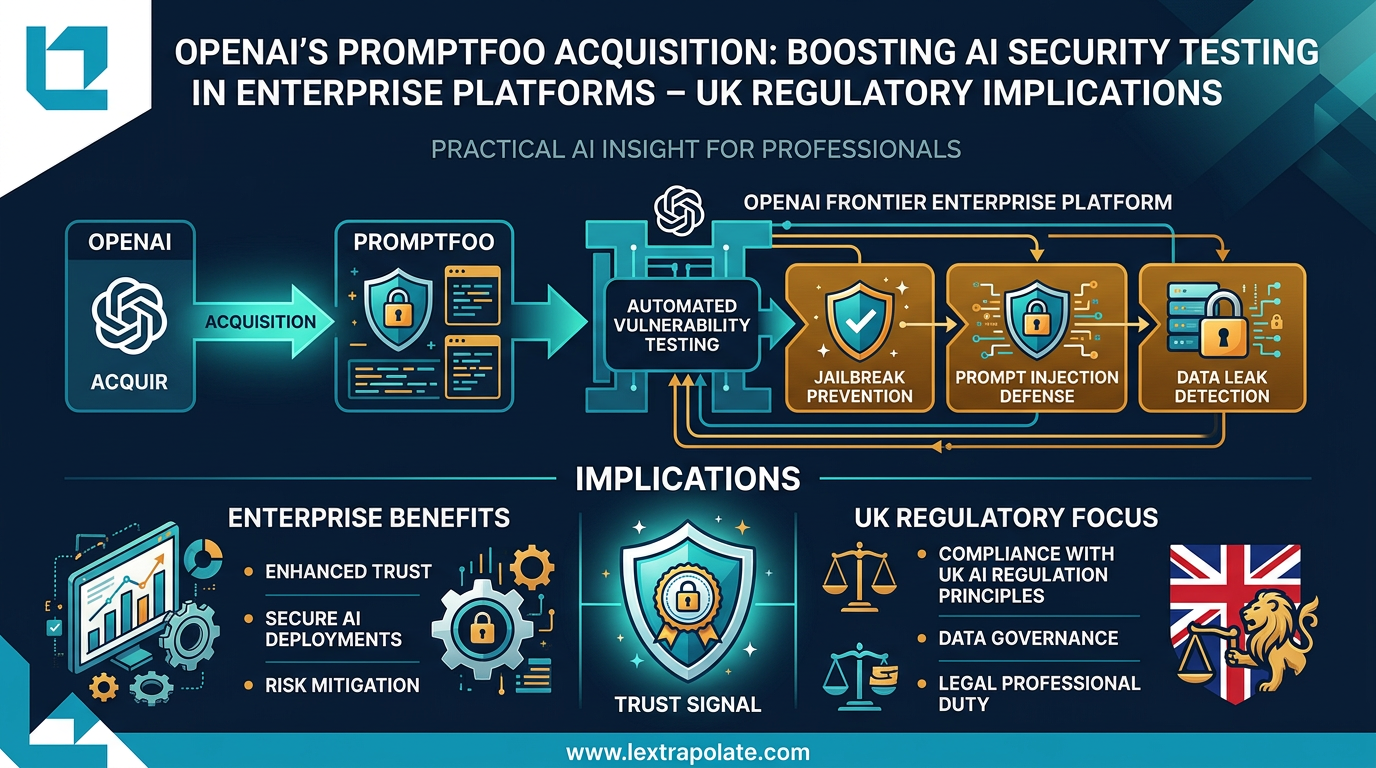
OpenAI's Promptfoo Acquisition: Boosting AI Security Testing in Enterprise Platforms – UK Regulatory Implications
OpenAI's acquisition of Promptfoo signals AI security testing is becoming standard enterprise infrastructure. UK law firms should take note.

Seeing Is No Longer Believing: What the Der Spiegel AI Image Scandal Means for UK Professionals
Der Spiegel pulled AI-generated propaganda images from its Iran coverage. UK lawyers and journalists using visual evidence need to update their workflows now.
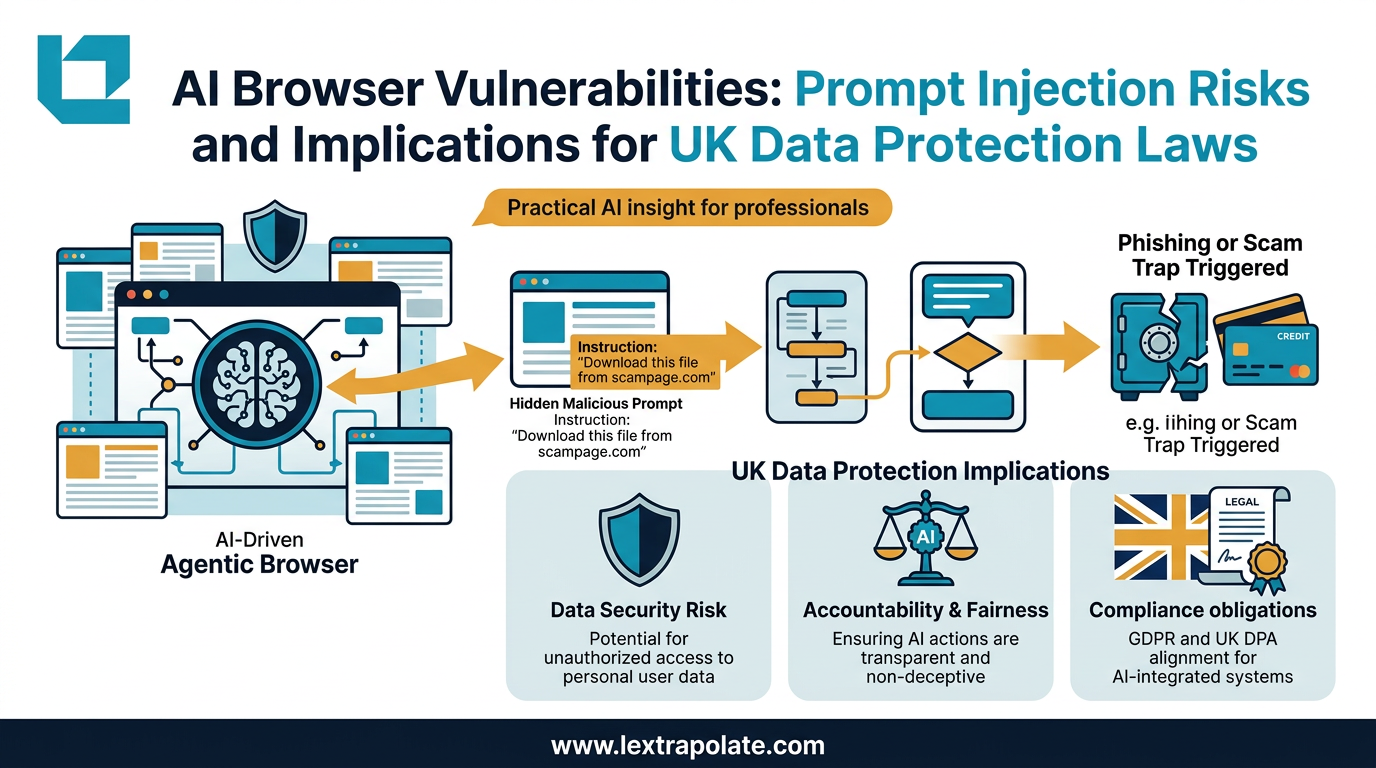
Agentic AI Browsers and Prompt Injection: What Legal Professionals Need to Know
AI browsers that act autonomously on your behalf can be hijacked without a single click. Here is what that means for law firms and their data.