The Lawyerless Law Firm: What SRA Approval of Technology-Only Practices Means in Practice
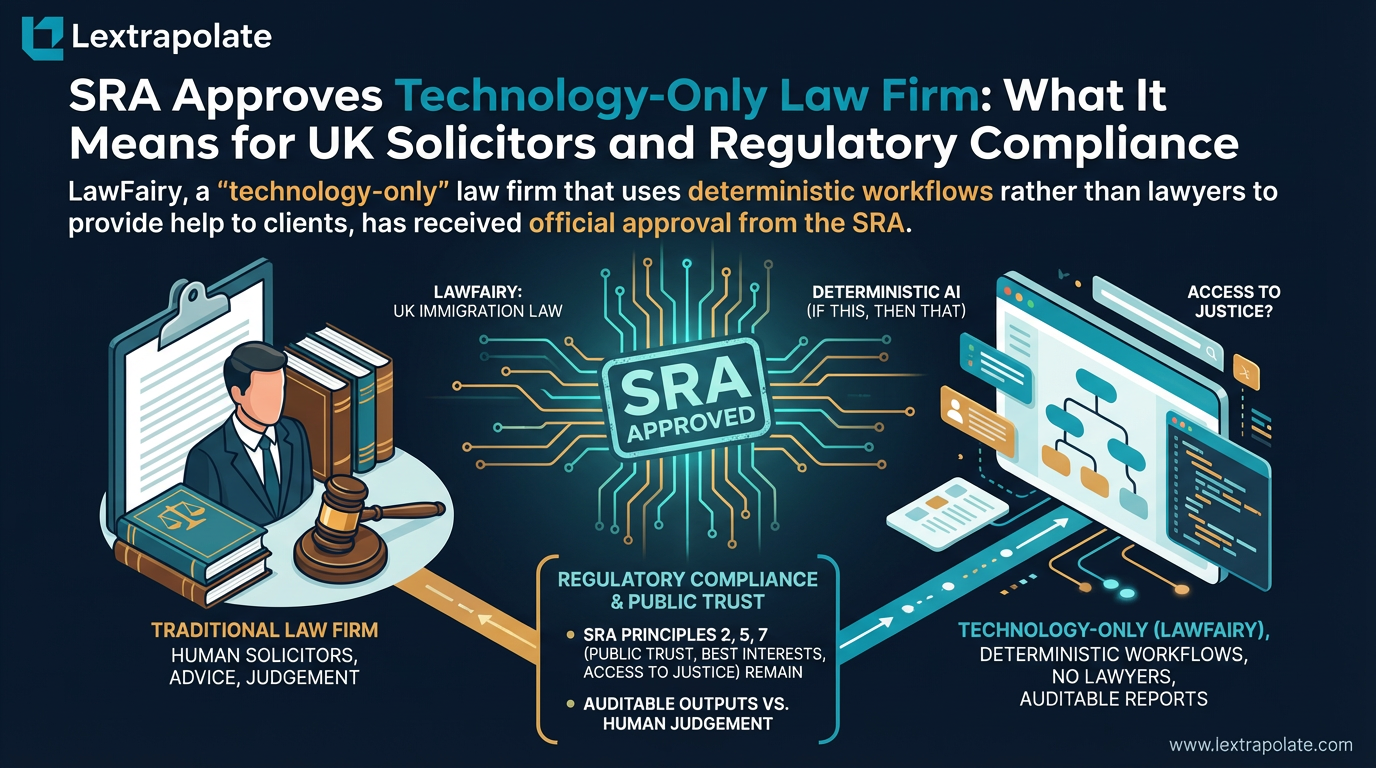
The SRA has authorised a law firm with no lawyers. Not a reduced-headcount firm, not a hybrid model. A firm where the work is done entirely by software.
That is not science fiction. It is current regulatory reality, and it has happened twice in under a year.
The concept deserves scrutiny, not celebration and not panic.
What Has Actually Been Approved
LawFairy Services Limited received SRA authorisation in February 2026, planning to launch in March. Its model focuses on UK immigration eligibility assessments. Users submit information, the system applies rules encoded as decision trees, and it produces an auditable report or checklist. No solicitor reviews the output before it reaches the client.
This follows Garfield.Law, which received SRA authorisation in May 2025 using a generative AI approach. Two data points do not make a trend, but they do make a direction of travel visible.
The distinction between the two models matters. LawFairy uses deterministic, rule-based workflows: if this, then that, encoded from statute. The output of any given input is fixed and predictable. Garfield.Law uses probabilistic AI, where outputs can vary. From a regulatory risk perspective, the deterministic approach is easier to audit and defend. Whether it is better for clients is a separate question.
I have not tested LawFairy's system and cannot evaluate its outputs. What I can evaluate is the regulatory and commercial logic of what the SRA has now sanctioned.
The Regulatory Question the SRA Has Answered, and the Ones It Has Not
The SRA's decision to authorise these firms signals a clear position: technology-only delivery of legal services can, in principle, satisfy the SRA Standards and Regulations. That is a significant statement.
But the Standards and Regulations do not simply dissolve because there is no human solicitor in the delivery chain. Principle 2 requires upholding public trust in solicitors and in legal services. Principle 5 requires acting in the best interests of each client. Principle 7 requires access to justice to be taken seriously. None of those principles become easier to satisfy when the person receiving a checklist about their immigration eligibility is a vulnerable individual with limited English, acting without an adviser, who cannot tell whether the eligibility assessment they have just received is correct or out of date.
The SRA's Standards and Regulations were written for human professionals exercising judgement. Applying them to algorithmic outputs requires interpretive work that the authorisation decision alone does not resolve. The SRA has said these firms can exist. It has not published detailed guidance on how the Principles apply to them, what supervision obligations attach, or what redress mechanisms clients must have when the workflow produces the wrong answer.
That gap will close eventually, probably after something goes wrong. The immigration context amplifies the stakes. A wrong eligibility assessment in an immigration matter is not an inconvenience. It can result in an application that should never have been made, or a route not taken that should have been.
The Commercial Logic and Its Limits
The economic case for this model is straightforward. LASPO gutted civil legal aid in 2013. Immigration legal aid was already restricted before that. Qualified solicitors are expensive. Millions of individuals face legal questions they cannot afford professional help with, and the unmet need is documented extensively. If a deterministic workflow can correctly identify that someone is eligible for a particular visa route in thirty seconds for a few pounds, that is genuinely useful.
The model also fits a category of legal work that is genuinely rule-application rather than advice. Immigration eligibility assessment at the screening stage is mostly statutory interpretation already done: Parliament set the rules, the Home Office publishes the requirements, the question is whether a given set of facts meets them. That is amenable to systematic encoding in a way that, say, advising on settlement strategy in contested litigation is not.
The commercial model, though, creates a structural tension worth naming. The technology developer and the regulated entity are not the same thing, but in practice they are closely related. The regulated firm relies entirely on the developer's software. If the software has a bug, encodes a superseded rule, or fails to handle an edge case, the regulated firm is the entity with SRA obligations. Whether that firm has meaningful capacity to identify and correct those failures without lawyers on staff is not obvious. The SRA will need to think carefully about how it monitors that, and what the corporate separation between developer and regulated entity actually achieves in practice.
What This Means
If you run a law firm, two things follow from this directly.
First, the competitive pressure is real but targeted. Technology-only models can undercut traditional firms on volume, predictable, rule-application work: eligibility assessments, document checklists, basic compliance reviews. If your firm does a lot of that work at low margins, the pressure is coming. If your firm does complex advisory work, it is not.
Second, this is a signal about regulatory appetite. The SRA has shown it will authorise genuinely novel delivery models if the application is coherent. If you have been thinking about restructuring how your firm delivers a particular service, whether through automation, AI, or a different staffing model, the SRA is not the obstacle you might have assumed it to be. The Standards and Regulations still apply in full. But the regulator is not reflexively hostile to new structures.
For individual solicitors, the more useful question is where deterministic legal workflows genuinely belong in a practice versus where they create risk. In my work at Lextrapolate, I see firms reaching for automation in places where the underlying legal question has more variability than it appears. Immigration eligibility looks clean until you hit an applicant with an unusual travel history, a prior refusal, or a dependent with complications. The workflow gives them an answer. Whether it gives them the right answer is what a professional would check.
A Genuine Shift, With Genuine Unknowns
The SRA authorising technology-only law firms is not a crisis for the profession. It is a narrowing of the space where traditional delivery models face no competitive alternative. That space was already narrowing.
The harder regulatory work is still ahead. How do the Principles apply when there is no human exercising professional judgement at the point of delivery? What does client protection look like in a firm with no solicitors? How does the SRA supervise software?
Those questions will be answered, one way or another. The profession should be part of answering them, rather than waiting to see what the regulator decides.
Sources
Stay ahead of the curve
Get practical AI insights for lawyers delivered to your inbox. No spam, no fluff, just the developments that matter.
Chris Jeyes
Barrister & Leading Junior
Founder of Lextrapolate. 20+ years at the Bar. Legal 500 Leading Junior. Helping lawyers and legal businesses use AI effectively and safely.
Get in TouchMore from Lextrapolate
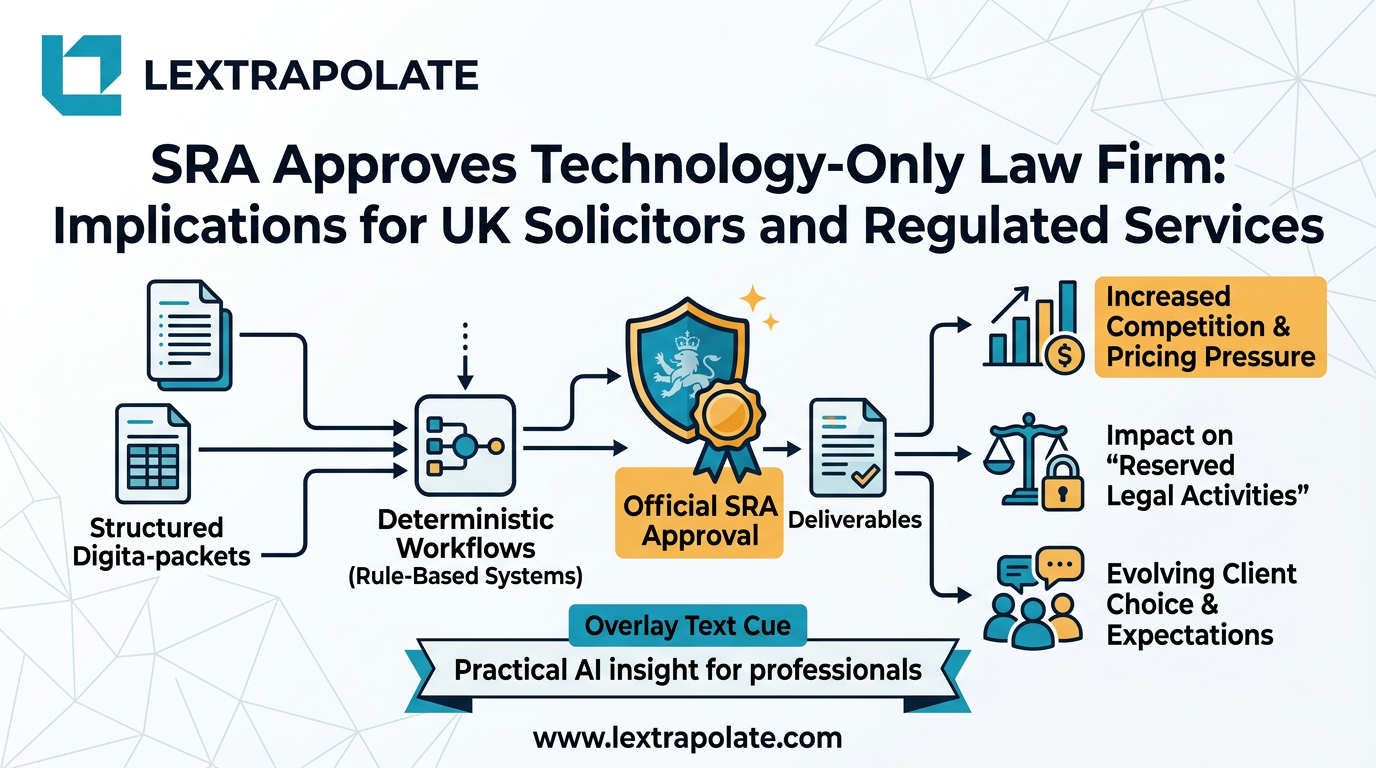
Lawyerless Law Firms: What the SRA's Approval of Deterministic Legal Tech Actually Means
The SRA has authorised a firm that delivers regulated legal services without lawyers. Here is what that precedent means for UK solicitors and the profession.

If AI Agents Become Your Workforce, What Happens to the Law Firm?
A hypothetical scenario playing out in China raises a serious question for legal practice: can a solo lawyer with AI agents compete with a mid-sized firm?
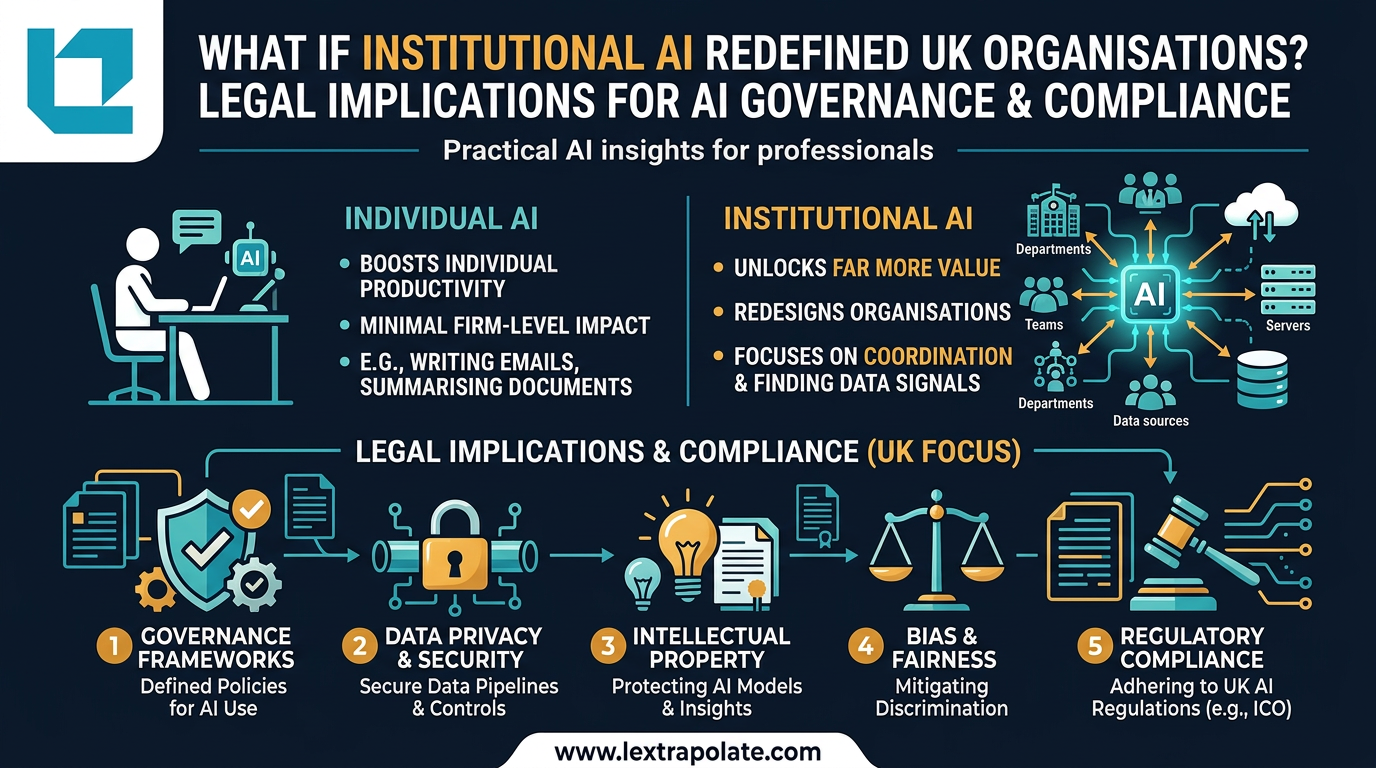
Your AI Is Working Hard. Your Firm Is Not: The Case for Institutional AI in Law
Individual AI makes lawyers faster. Institutional AI could remake law firms entirely. Most firms are pursuing the former and missing the latter.