Lawyerless Law Firms: What the SRA's Approval of Deterministic Legal Tech Actually Means

The SRA has authorised a firm that delivers regulated legal services without a single practising solicitor involved in the delivery. That is not a thought experiment. It happened on or around 24 February 2026.
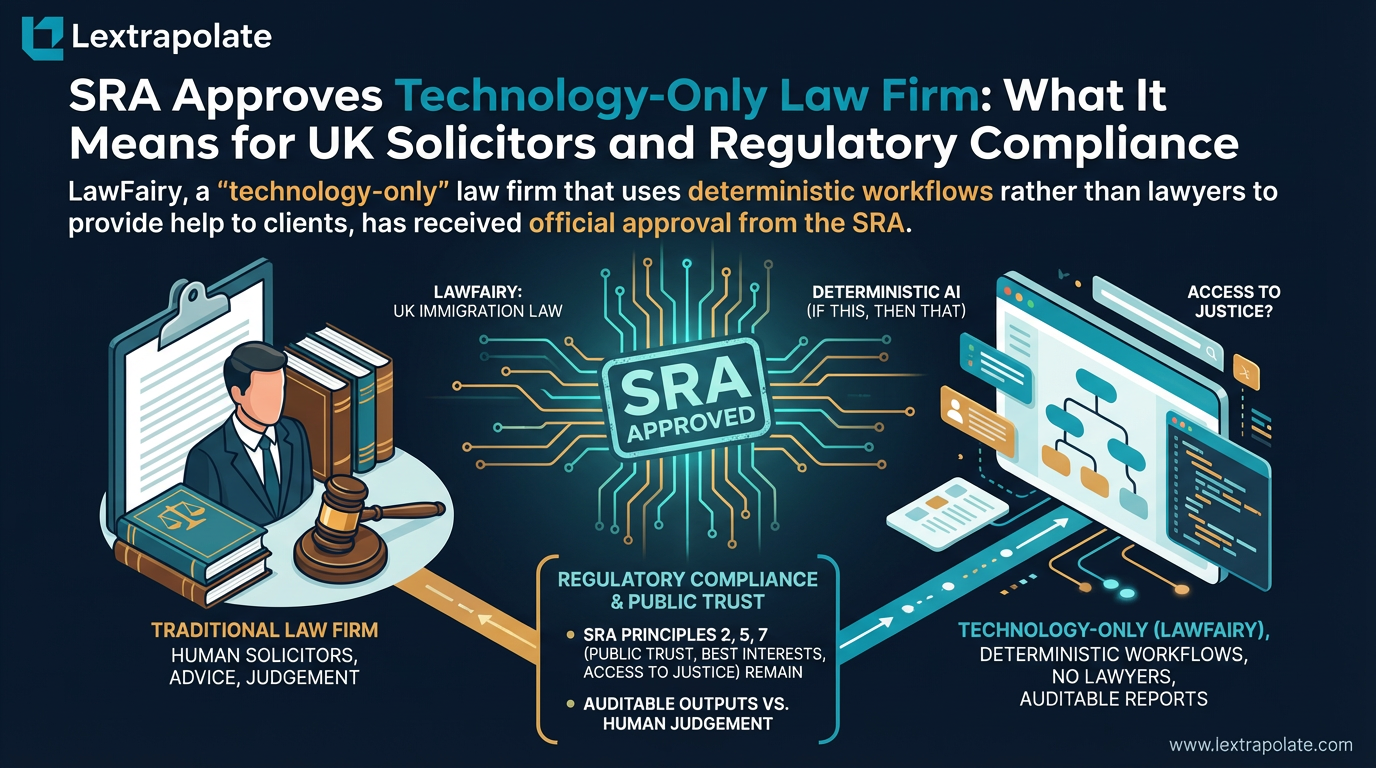
The firm is LawFairy Services Limited. It uses deterministic, rule-based workflows to assess clients' eligibility under UK immigration rules, producing auditable reports and checklists. No generative AI. No lawyers in the loop. Just encoded statute, decision trees, and outputs the client can act on.
The coverage has been enthusiastic. Some of it reads like a press release with a byline. I have not tested LawFairy's product, and nothing here should be read as an endorsement of their specific claims. Their website seems to be still in construction. What matters is the regulatory precedent, because that belongs to everyone in the profession, not just one company's marketing team.
What the SRA Has Actually Authorised
LawFairy is the second technology-only firm to receive SRA authorisation, following Garfield, which was approved in May 2025. Both operate as Alternative Business Structures under the Legal Services Act 2007, and both separate the regulated legal entity from the underlying technology developer.
That structural separation is deliberate and significant. The regulated entity carries the SRA obligations. The tech company builds and maintains the engine. Responsibility sits with the authorised body, not the software vendor. That is the same model a traditional firm uses when it outsources IT, except here the IT is doing the legal work.
The SRA's authorisation signals that the Standards and Regulations 2019 can accommodate non-lawyer delivery, provided outcomes under paragraphs 1.1 to 1.4 are met and the work is genuinely deterministic. Immigration eligibility is a sensible starting point. Visa rules are dense, largely binary, and change by statute. If you meet the criteria, you qualify. If you do not, you do not. There is limited room for professional judgement in the assessment itself, though there is plenty of room for it in deciding what to do with that assessment.
That distinction matters enormously.
Deterministic Systems Are Not Magic, and They Are Not Neutral
A deterministic legal engine encodes statute into a decision tree. Every input maps to a defined output. The system cannot hallucinate, because it does not generate text from probabilistic models. It executes pre-written logic. That makes it auditable and consistent in a way that generative AI currently is not.
But consistent execution of faulty logic is still faulty. The risk with deterministic systems is not randomness. It is brittleness. Statute changes. Home Office guidance shifts. Edge cases emerge that the original decision tree did not anticipate. Someone has to maintain the logic, test it against new rule-sets, and catch the gap between what Parliament enacted and what the system currently codes for.
That maintenance burden does not disappear because there are no lawyers in the delivery chain. It concentrates at the point of system design and ongoing governance. The SRA's Principles 4 and 7 require firms to act with integrity and in clients' best interests. Those obligations do not evaporate because a machine is doing the work. They fall on the regulated entity's responsible individuals, whoever they are.
Vulnerability is a further pressure point. Immigration clients often present in difficult circumstances: language barriers, time pressure, complex personal histories. A rules engine cannot pick up that a client has misunderstood the question, or that the answer they gave was incomplete. A solicitor can. The access-to-justice case for technology-delivered services is real, but so is the risk of clients receiving an output they cannot interpret and acting on it without understanding its limits.
We do not yet have independent evidence of how LawFairy handles these scenarios in practice. That warrants evaluation before drawing firm conclusions about the model.
What This Means for Conventional Firms
The SRA's 2024 to 2027 strategy explicitly links technology to access to justice. Two authorisations in under a year suggests the regulator is willing to approve further applications where the work is sufficiently rule-dense and the governance structure is sound.
That should prompt firms to ask a harder question than "could we be replaced by this?" The better question is: which parts of our current work are we treating as professional services when they are actually process execution?
Immigration eligibility assessments. Residential conveyancing searches. Basic probate asset schedules. Many law firms charge professional rates for tasks that are, in substance, structured data collection against a fixed rule-set. That is not a criticism. It reflects the regulatory environment that existed until recently. But the environment has changed.
Firms that identify these process-dense areas and automate them internally will protect margin. Firms that continue to staff them with junior fee-earners billing time will find the economics increasingly difficult to defend, whether the competitive pressure comes from technology-only firms or from other law firms that have moved faster.
The billable hour is not abolished by LawFairy's authorisation. But the authorisation makes visible a category of legal work where billing by time was always a proxy for something that could be priced differently.
The Monday Morning Question
If you run a practice, or manage a team, the useful exercise is not to read about LawFairy and conclude it is interesting. It is to map your current matter types and ask which of them are primarily eligibility assessments dressed up as legal advice.
Start with the work your trainees and paralegals do most. If the task involves taking client information, checking it against a fixed rule-set, and producing a structured output, that task can probably be encoded. Whether it should be is a separate question, involving client relationship, risk appetite, and regulatory structure.
The firms that will find this hardest are those that have never distinguished between process and judgement in their own workflows. They have been delivering both, charging for both, and conflating the two for so long that the map has become the territory.
The SRA's decision creates space for others to disaggregate that bundle. The question is whether incumbent firms do it to themselves before someone else does it for them.
A Genuine Milestone, With Caveats
The SRA's authorisation of technology-only firms using deterministic workflows is a meaningful regulatory development. It confirms that regulated legal services can be delivered without lawyers, in defined circumstances, under a governance structure that satisfies the Standards and Regulations 2019.
That is not the end of the legal profession. Interpretative law, advocacy, negotiation, and genuine strategic advice are not susceptible to decision trees. But it is a structural shift in what counts as a law firm and who can deliver certain categories of legal work.
The promotional tone of some coverage around LawFairy should not obscure the underlying significance. And the significance should not obscure the unanswered questions about how deterministic systems perform under real-world pressure, how they handle vulnerable clients, and how their logic is maintained when the rules change.
Both things are true. This is a genuine milestone, and it deserves scrutiny proportionate to what it actually claims to do.
Sources
- 1Legal AI Co. LawFairy Gains SRA Authorization
- 2SRA greenlights fully tech-delivered law firm LawFairy - Non-Billable
- 3LawFairy 'Technology-Only Law Firm' Gets Regulatory Approval
- 4Non-AI technology-only law firm authorised by SRA - Legal Futures
- 5UK Greenlights LawFairy: The Deterministic Tech-Only Law Firm That Actually Follows the Rules
Stay ahead of the curve
Get practical AI insights for lawyers delivered to your inbox. No spam, no fluff, just the developments that matter.
Chris Jeyes
Barrister & Leading Junior
Founder of Lextrapolate. 20+ years at the Bar. Legal 500 Leading Junior. Helping lawyers and legal businesses use AI effectively and safely.
Get in TouchMore from Lextrapolate
The Lawyerless Law Firm: What SRA Approval of Technology-Only Practices Means in Practice
The SRA has now authorised two technology-only law firms. No solicitors, no advice, just automated workflows. That deserves serious scrutiny.

If AI Agents Become Your Workforce, What Happens to the Law Firm?
A hypothetical scenario playing out in China raises a serious question for legal practice: can a solo lawyer with AI agents compete with a mid-sized firm?

Your AI Is Working Hard. Your Firm Is Not: The Case for Institutional AI in Law
Individual AI makes lawyers faster. Institutional AI could remake law firms entirely. Most firms are pursuing the former and missing the latter.