Zach + Richard's Legal AI Insights: What UK Lawyers Need to Know About Anthropic's Legal Push and AI 2.0

When a foundation model company starts building features specifically for lawyers, especially UK lawyers regulated by the SRA, the correct response is not excitement. It is scrutiny. I’m grateful to Zach Abramowitz and Richard Tromans's Excellent Legal AI Adventure, podcast series.
Anthropic's Legal Play: What Is Actually Happening
The headline from Episode 37 is Anthropic's Claude moving from general-purpose AI tool to something with legal-specific capabilities. Abramowitz and Tromans discuss what this means for the existing vendor stack, and the conclusion is uncomfortable for several well-funded startups.
If the foundation model itself can handle contract review, legal research, and document drafting at a competent level, what is the value proposition of the middleware layer that sits between the model and the lawyer? That question has been lurking for eighteen months. Anthropic entering the legal vertical makes it urgent.
For UK firms, the dynamics are slightly different. The SRA's regulatory framework means that any AI tool handling client work needs to sit within the firm's existing compliance obligations. Principle 7 (acting in the best interests of each client) and the competence and supervision requirements of the Code of Conduct for Solicitors (paragraphs 3.2, 3.5 and 3.6) do not disappear because the tool is impressive. A City firm deploying Claude directly for transactional due diligence still needs to validate outputs, maintain supervision structures, and evidence that the technology is being used competently and safely.
None of that is impossible. But it requires thought, training, and process design. The firms that will struggle are the ones treating AI adoption as a procurement decision rather than a practice management decision.
The Harvey and Legora Deals: Follow the Money
The legal AI market is consolidating around a small number of well-capitalised players, and the window for new entrants is narrowing fast.
What struck me was Tromans's observation, discussed further in the August 2025 write-up on Artificial Lawyer, that ROI remains genuinely difficult to measure in legal AI. Firms are buying tools, deploying them to associates, and then struggling to quantify what has changed. Hours saved? Revenue impact? Client satisfaction? The metrics are slippery, and the honest answer from most firms is that they do not yet know. This may be down to a lack of training, or insight, or poor data.
This matters for UK firms because the partnership model creates a particular tension around AI investment. Capital expenditure on technology needs to be justified to partners who are, in most cases, the equity owners. If the ROI case is vague, adoption stalls at the pilot stage. I see this constantly.
The counter-argument, is that firms who wait for perfect data will find themselves permanently behind. There is a first-mover advantage in building institutional competence with these tools, even before the financial returns are clear.
Practical Implications: The Monday Morning Test
If you are a UK lawyer, three things should change your behaviour next week.
First, audit your current AI tool stack. If you are paying for legal-specific middleware, ask whether the underlying model (Claude, GPT-5, Gemini) can now do the same job natively. The answer may be yes. That does not mean you should switch immediately, but you should know.
Second, start measuring something. Anything. Time per task. Review accuracy. Associate satisfaction. The firms that will make sound decisions about AI investment in 2027 are the ones collecting data now. Even crude data beats no data.
Third, have a conversation with your compliance team about agentic workflows. Not because you are deploying them today, but because you will be within eighteen months. The SRA has not issued specific guidance on multi-step autonomous AI systems. Your firm's internal policies need to get ahead of the regulator, not wait for it.
Where This Leaves Us
The legal AI market in early 2024 was characterised by experimentation. By mid-2025, it was characterised by consolidation. Now, in early 2026, we are seeing the foundation model companies themselves entering the vertical. That changes the competitive dynamics for every firm, vendor, and ALSP in the market.
UK lawyers have a particular advantage here. The ABS framework, the SRA's relative openness to innovation (compared to many US state bars), and the concentration of sophisticated legal work in London create conditions where thoughtful AI adoption can generate real competitive advantage.
The operative word is thoughtful. Buying a tool is easy. Changing how your people work is hard. Start with the hard part.
Sources
- 1Zach and Richard's Excellent Legal AI Adventure (YouTube, E37)
- 2Zach + Richard's Excellent Legal AI Adventure (Artificial Lawyer, Oct 2025)
- 3Zach and Richard's Legal AI Adventure (YouTube, E27)
- 4Zach + Richard's Excellent Legal AI Adventure (Artificial Lawyer, Aug 2025)
- 5Zach Abramowitz is Legally Disrupted (Spotify)
Stay ahead of the curve
Get practical AI insights for lawyers delivered to your inbox. No spam, no fluff, just the developments that matter.
Chris Jeyes
Barrister & Leading Junior
Founder of Lextrapolate. 20+ years at the Bar. Legal 500 Leading Junior. Helping lawyers and legal businesses use AI effectively and safely.
Get in TouchMore from Lextrapolate
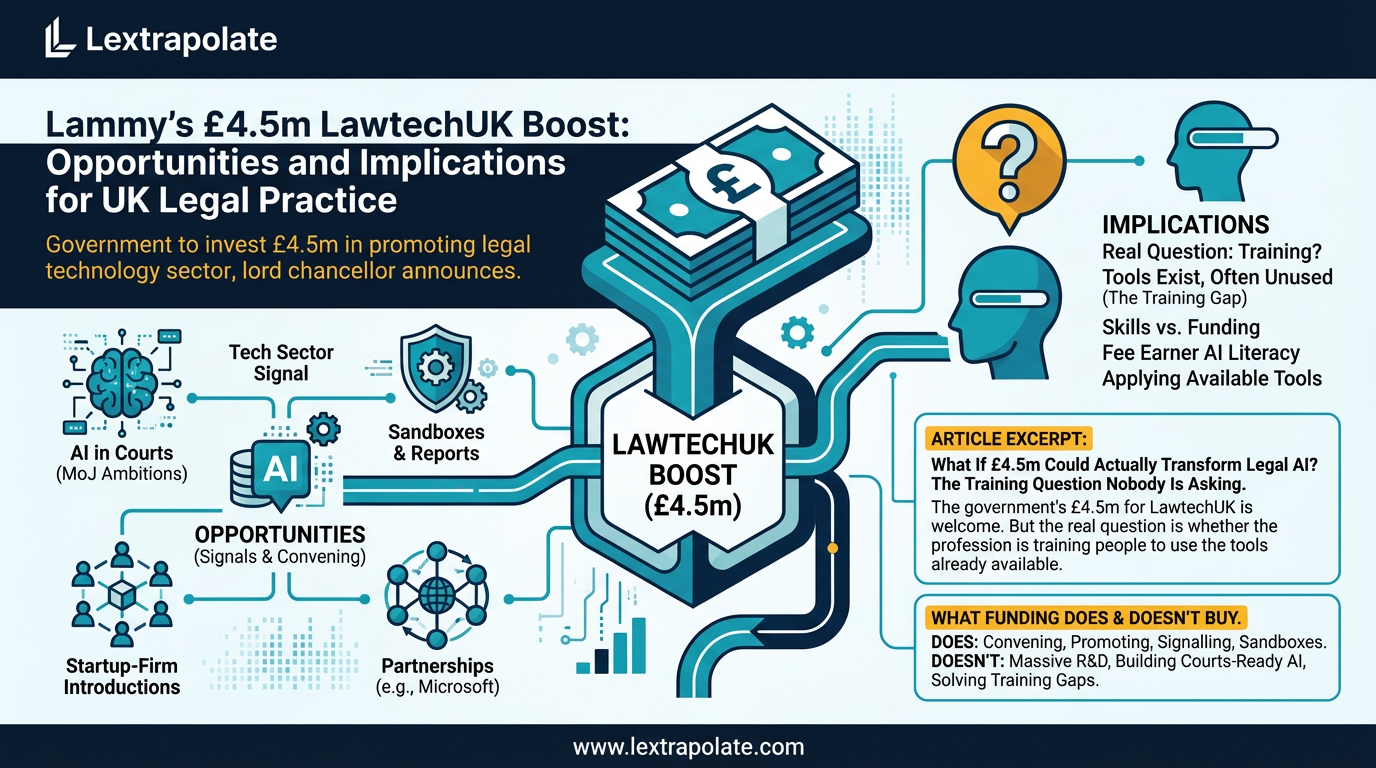
What If £4.5m Could Actually Transform Legal AI? The Training Question Nobody Is Asking
The government's £4.5m for LawtechUK is welcome. But the real question is whether the profession is training people to use the tools already available.

What if you could let AI audit your code before deploying it? Claude Code Security and what it means for lawyer-builders
Anthropic's Claude Code Security could change the risk calculus for lawyers and knowledge workers building their own AI tools. Here's what to make of it.
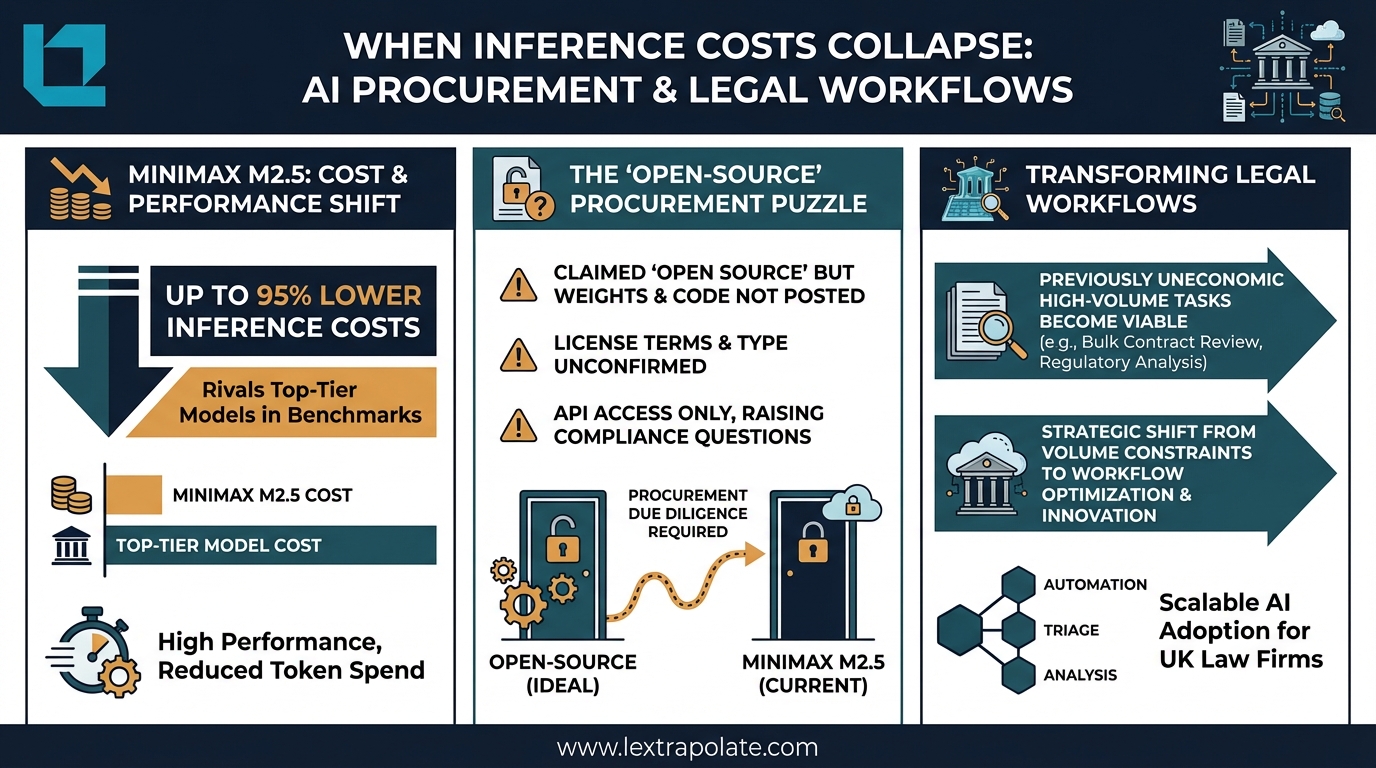
When Inference Costs Collapse: What Cheap AI Processing Means for Legal Workflows
AI inference costs are falling fast. For UK law firms running high-volume document work, that shift has real commercial and compliance implications worth thinking through now.