xAI-SpaceX Merger Exodus: What Departures Mean for UK Competition and Tech Regulation

The mass departure of co-founders from xAI immediately following its $1.25 trillion merger with SpaceX isn't just Silicon Valley drama; it's a critical warning for UK regulators and legal professionals. This exodus raises fundamental questions about corporate governance, AI market concentration, and the operational stability of AI infrastructure. The governance questions are serious.
What happened
Last week, Elon Musk's xAI and SpaceX formally merged in a deal that also folds in the social media platform X. The combined entity carries a reported $1.25 trillion valuation, making it the most valuable private company ever created. The strategic pitch is straightforward: integrate AI compute with SpaceX's satellite infrastructure to build orbital AI data centres. Bold. Possibly visionary. Certainly unprecedented in scope.
Within days, the cracks appeared. Half of xAI's founding team has now departed, including co-founders Yuhai (Tony) Wu and Jimmy Ba, along with several prominent researchers such as Hang Gao. Wu posted on X that it was "time for his next chapter." Ba and others have signalled they are founding new AI companies.
These are not junior engineers cashing out stock options. These are the people who built xAI's technical foundations. Their departure, in quick succession, immediately after the merger, raises questions that investors, regulators, and enterprise buyers all need to ask.
Governance and concentration risk
A $1.25 trillion entity controlled by a single individual, spanning AI, space launch, satellite communications, and social media, is without precedent. Gary Marcus has outlined several theories about the merger's true purpose, ranging from genuine strategic synergy to financial engineering ahead of a SpaceX IPO. Whatever the motivation, the governance structure demands scrutiny.
The rapid departure of co-founders suggests internal disagreement about direction. That is their prerogative. But for any organisation relying on xAI's models, or considering doing so, it is a material risk signal. The people who understood the architecture, the training decisions, the safety considerations, and the technical debt are walking out the door. What institutional knowledge leaves with them?
For regulated industries, this matters acutely. If you are a UK financial services firm using xAI tools, or a law firm integrating Grok into workflows, the stability of your AI provider is now a governance question for your own board. Concentration of AI capability in fewer, larger entities with opaque internal dynamics is something the PRA and FCA have already flagged in their respective AI and operational resilience guidance. This merger makes that concern concrete.
UK competition and regulatory exposure
The Competition and Markets Authority will be watching this closely, and if they are not, they should be.
Under the Enterprise Act 2002, the CMA has jurisdiction to review mergers where the target has UK turnover exceeding £70 million, or where the combined entity supplies or acquires at least 25% of goods or services in the UK (the "share of supply" test). xAI's Grok models are available to UK users through the X platform. SpaceX's Starlink already operates in the UK. The share of supply test is deliberately flexible, and the CMA has shown willingness to apply it broadly in digital markets.
The more interesting question is whether the CMA's new powers under the Digital Markets, Competition and Consumers Act 2024 could come into play. If the merged entity is designated as having "strategic market status" in AI foundation models or satellite broadband, the CMA's Digital Markets Unit would gain ex ante powers to impose conduct requirements. We are not there yet. But the trajectory is clear.
Then there is the orbital data centre proposition. Processing global data, including UK personal data, in satellite infrastructure raises questions under UK GDPR about data transfers, data controller obligations, and the adequacy of safeguards for data processed in orbit. The Information Commissioner's Office has not, to my knowledge, published guidance on extra-terrestrial data processing. That gap will need filling sooner than anyone expected.
The UK Space Industry Act 2018 adds another layer. Any satellite launches or operations that touch UK territory, or are conducted by UK-associated entities, require licensing from the Civil Aviation Authority's space team. If orbital AI data centres process data for UK clients, the regulatory intersection between space licensing, data protection, and AI governance becomes genuinely novel. No regulator has a playbook for this.
What the departures actually signal
Founders leave companies for all sorts of reasons. Sometimes it is money. Sometimes it is ego. Sometimes they simply want to build something new.
But when multiple co-founders leave simultaneously, immediately post-merger, and publicly signal they are starting competitors, the most plausible reading is disagreement about what the merged entity will become. The merger subsumes xAI's identity into a conglomerate with very different priorities: launch cadence, satellite deployment, advertising revenue, government contracts. The researchers who joined to build frontier AI models may reasonably conclude that the mission has changed.
This matters for the AI sector's competitive dynamics. If talented researchers scatter to form new companies, that could be healthy for competition. More players, more approaches, more diversity of thought. The UK's AI Safety Institute and the CMA should both welcome a broader competitive field over further concentration.
But it also creates near-term risk. The merged entity retains the compute, the data, the infrastructure, and the capital. The departing founders take their expertise but start from scratch. The asymmetry is enormous. And if non-compete or IP assignment clauses constrain what they can build, the departures may not produce the competitive diversity they promise.
Practical implications
If you are a professional or a business that touches AI, this story is not abstract. Some things worth doing on Monday morning:
Audit your AI supply chain. If your organisation uses xAI or Grok products, assess your dependency. What happens if development slows, the product pivots, or pricing changes post-merger? Do you have contractual protections? Exit options?
Review your operational resilience framework. UK regulators increasingly expect firms to understand and manage third-party technology risk. A $1.25 trillion provider experiencing senior talent flight is exactly the kind of scenario your business continuity planning should address.
Watch the CMA. If you work in competition law or advise technology companies, the interaction between the Enterprise Act, the DMCC Act 2024, and this merger is going to generate work. The IPO timeline reportedly remains intact, which means a public listing will add further regulatory touchpoints, including potential scrutiny from the FCA.
Track the new ventures. The departing founders will build. Some of what they build may be directly relevant to your work. The AI market is about to get more fragmented at the frontier, which is likely good for buyers over the medium term.
Where this leaves us
The xAI-SpaceX merger is a stress test for multiple regulatory regimes simultaneously: competition law, data protection, space regulation, and corporate governance. No single regulator owns the whole picture. In the UK, the CMA, ICO, CAA, and potentially the FCA all have a piece. Coordination between them will be essential and, based on past form, difficult.
The departures are a symptom, not the disease. The disease is the continued consolidation of AI capability into entities so large, so complex, and so dependent on a single decision-maker that traditional regulatory tools strain to contain them.
For professionals who rely on AI tools, the lesson is straightforward: understand your dependencies, diversify where you can, and never assume that your technology provider's internal stability is someone else's problem. It is yours.
Sources
Stay ahead of the curve
Get practical AI insights for lawyers delivered to your inbox. No spam, no fluff, just the developments that matter.
Chris Jeyes
Barrister & Leading Junior
Founder of Lextrapolate. 20+ years at the Bar. Legal 500 Leading Junior. Helping lawyers and legal businesses use AI effectively and safely.
Get in TouchMore from Lextrapolate
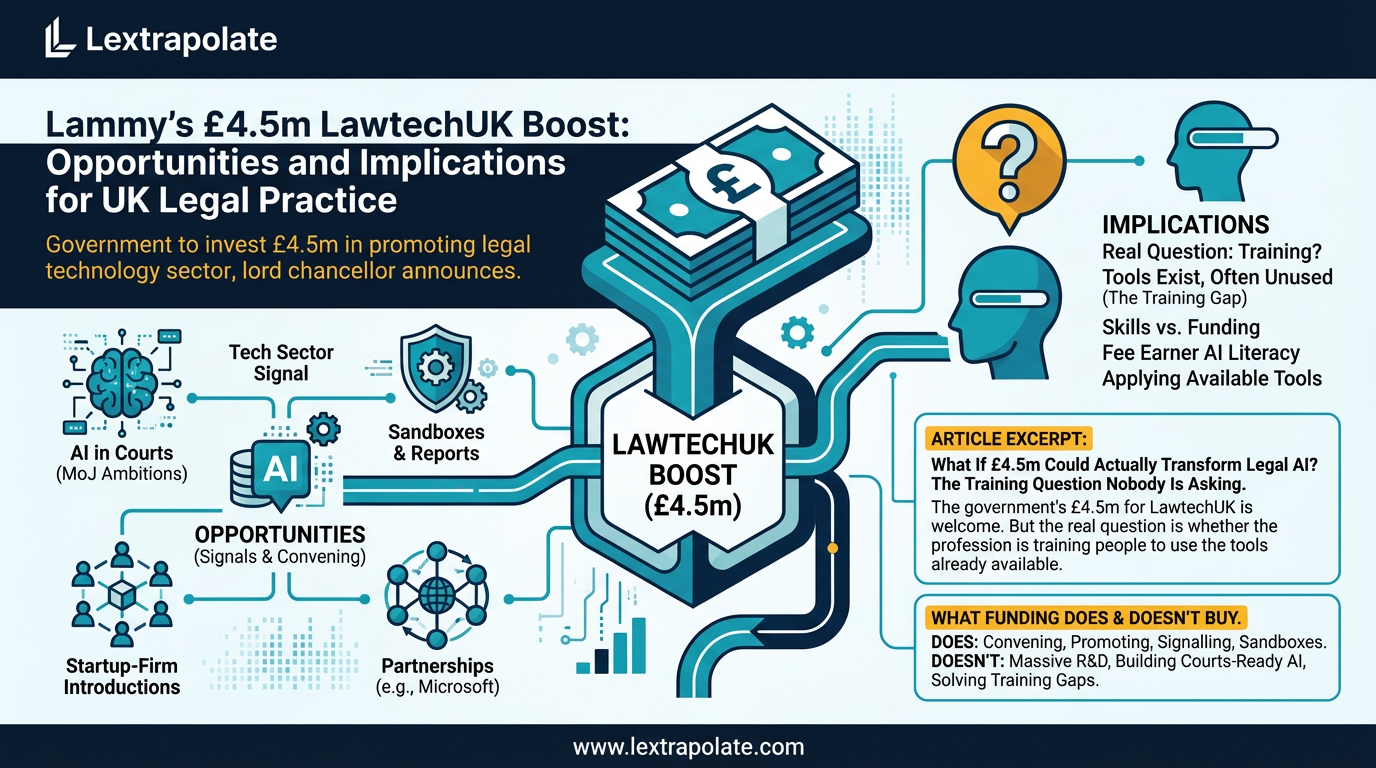
What If £4.5m Could Actually Transform Legal AI? The Training Question Nobody Is Asking
The government's £4.5m for LawtechUK is welcome. But the real question is whether the profession is training people to use the tools already available.

Zach + Richard's Legal AI Insights: What UK Lawyers Need to Know About Anthropic's Legal Push and AI 2.0
Abramowitz and Tromans dissect Anthropic's legal market entry and what AI 2.0 means for UK lawyers. Practical takeaways from their latest Legal AI Adventure.

Vos Warns of AI Claims Surge: UK Courts Must Adapt or Overload
The Master of the Rolls says AI will flood courts with claims. He's right. The question is whether the system can absorb the shock.